Why Your 2026 Sales Tech Stack Needs an "Agentic Layer"
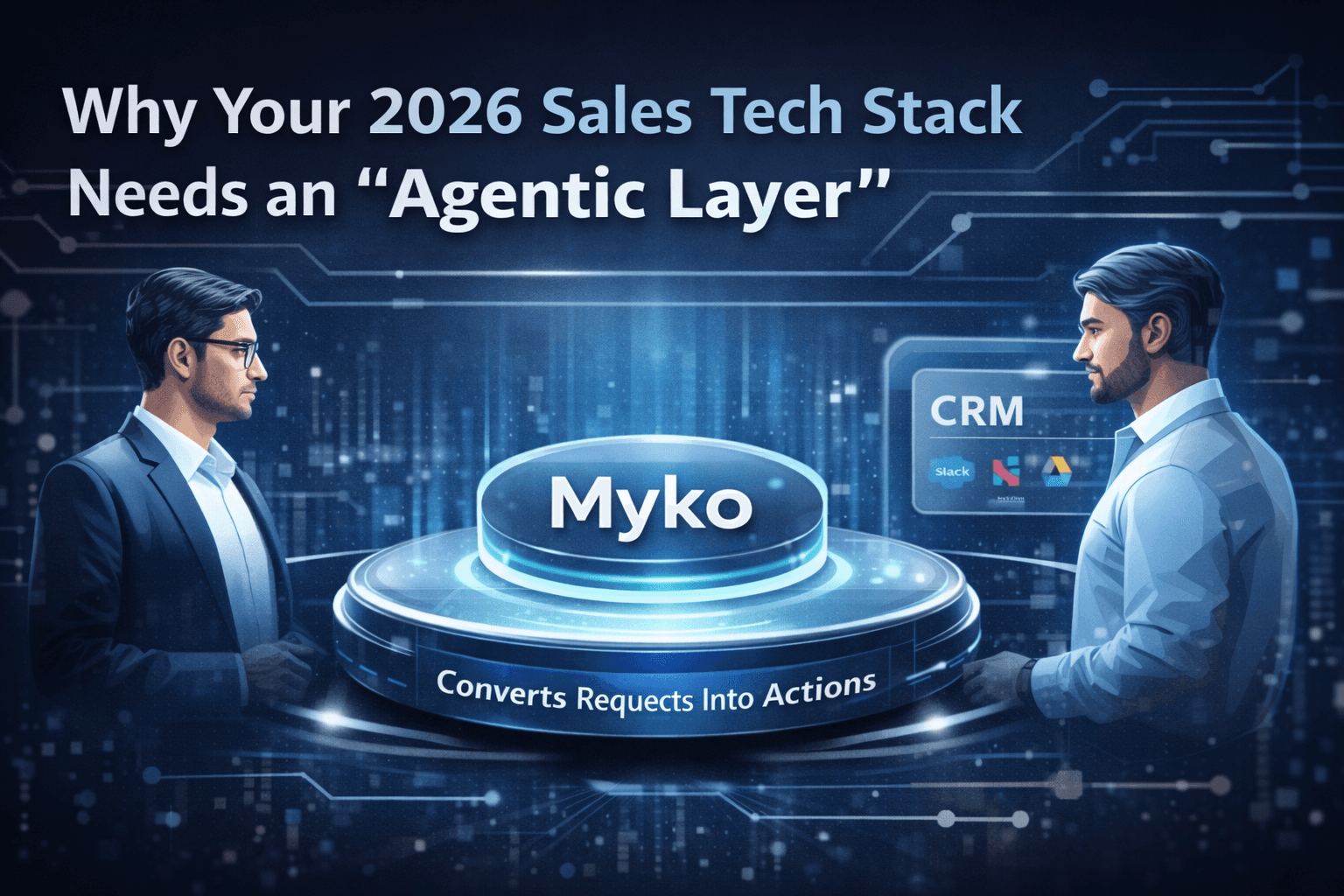
Key Takeaway: An Agentic Layer is a software tier that translates human intent into software actions across a sales stack. In 2026, this layer (represented by platforms like Myko) sits between the salesperson and the CRM. It replaces the traditional UI with a conversational interface, allowing for complex multi-app workflows - such as updating a lead, sending a calendar invite, and alerting a manager - through a single voice command.
The Evolution of the Sales Stack
For the past decade, the sales tech stack has been a collection of specialized silos. You had one tool for routing, one for lead intelligence, another for email sequencing, and, of course, the CRM acting as the heavy, static database at the center.
The problem with this "best-of-breed" approach is that the salesperson became the manual bridge between all these apps. To move a deal forward, a rep had to log into three different platforms, copy-pasting data and clicking through dozens of menus. By 2026, this "UI-heavy" model has reached a breaking point. Sales teams are now moving toward an Agentic Layer - a simplified, voice-first interface that orchestrates the entire stack so the rep never has to touch the underlying software.
What is an Agentic Layer?
It’s one interoperable layer that sits on top of your existing software. On one side, it speaks the language of the salesperson (natural, unstructured voice or text). On the other side, it speaks the language of your tech stack (API calls, data schemas, and CRM logic).
Unlike a standard integration that just moves data from one place to another, an agentic layer like Myko possesses "agency." It understands the context of a request and can execute a series of steps across multiple platforms simultaneously. When a rep says, "The meeting with ABC Corp went great, they want to see a proposal next week," the Agentic Layer doesn't just record that note. It interprets the intent and triggers a chain reaction:
It updates the deal stage in Salesforce.
It creates a follow-up task in the rep’s calendar.
It pings the sales engineer on Slack to prepare technical specs.
It pulls recent case studies into a draft email for the rep to review.
Solving the "UI Fatigue" Crisis
The primary reason companies are adopting an Agentic Layer in 2026 is the total exhaustion of the modern salesperson. Every new tool added to the stack in recent years has come with a new dashboard, a new login, and a new set of buttons to learn.
An Agentic Layer provides a "No-UI" experience. It allows the rep to stay in their "flow state" - talking to customers and driving between appointments - while the AI handles the software interactions in the background. By removing the need to navigate complex interfaces, companies are seeing a massive spike in CRM adoption and data accuracy. The software finally works at the speed of the salesperson.
Orchestrating the Entire Revenue Ecosystem
The true power of the Agentic Layer is that it isn't limited to the CRM. It acts as an operating system for the entire revenue organization.
Cross-Platform Automation: An agentic layer can bridge the gap between your CRM (Salesforce/HubSpot), your communication tools (Slack/Teams), and your document systems (Google Drive/Sharepoint).
Logic-Aware Updates: Traditional automation is "if-this-then-that." Agentic AI is "if-this-then-understand-and-execute." It can handle nuances, like realizing that a "follow-up next week" means a different date depending on whether today is Monday or Friday.
Real-Time Data Enrichment: While a rep is speaking their update, the Agentic Layer can cross-reference LinkedIn data or company news to enrich the CRM record automatically, ensuring that the next person to touch the account has a 360-degree view.
The Future of Sales Infrastructure
The companies winning in 2026 are not the ones with the most tools; they are the ones with the most integrated and accessible tools. The "Agentic Layer" is the final piece of the puzzle that turns a fragmented tech stack into a unified revenue engine.
If your sales team is still spending hours every week clicking through dropdown menus and manually syncing data between apps, you aren't just losing time—you’re losing market share. Moving to an agentic model with Myko allows your team to stop managing software and start managing relationships.